
Your reading plan
- One to two A4 pages, no photo unless the form asks, newest job first.
- Leave room for a one-line right to work and, for a foreign degree, its NFQ level.
- Choose one column for the public service or an unknown system, and two columns only when a sidebar earns its space.
What should an Irish CV template do?
EURES, the EU job mobility network, describes an Irish CV as one to two pages and notes that a photograph is supplied only if the application form asks for one (EURES). gradireland tells graduates to aim for one page, with two as the absolute maximum (gradireland).
So an Irish template is judged on room and restraint. It has to hold the CV to two A4 pages, avoid a photo slot you feel obliged to fill, and give a fixed place to the extra lines that international applicants add. Irish and UK CVs share most of their format, so the UK CV template page and this one agree on the basics; the differences are below.
Run your current CV through the free resume checker and the ATS resume checker before you move it into a new layout. For what to write in each section, read the Irish CV format and cover letter guide.
Where do the Irish extras go in a template?
Four details separate an Irish CV from a generic one. Each needs a fixed place in the layout, so decide where it goes before you choose a design.
Scroll sideways to see every column
| Detail | Where it goes | What to choose |
|---|---|---|
| Right to work | One line under your contact details, for example “Stamp 1G: full-time work permitted until 06/2027”. | Zenith, Core and Pulse all fix the header at the top, so the line sits where a recruiter looks first. |
| NFQ level of a foreign degree | On the education line, for example “comparable to NFQ Level 8, NARIC Ireland”. | A one-column design gives the line full width, so it does not wrap. |
| Referees | Two names at the end, or “References available on request”. | List names only if side two has room; a one-page graduate CV keeps the single line. |
| Photo | None, unless the application form asks for one. | Every design on this page is photo-free; Flux, Prism and Mosaic can place one if a form insists. |
The wording for each line is in the Irish CV guide, checked against Citizens Information, QQI and the immigration stamps page. Write only what your permission and your NARIC statement actually say.
Which design suits which Irish applicant?
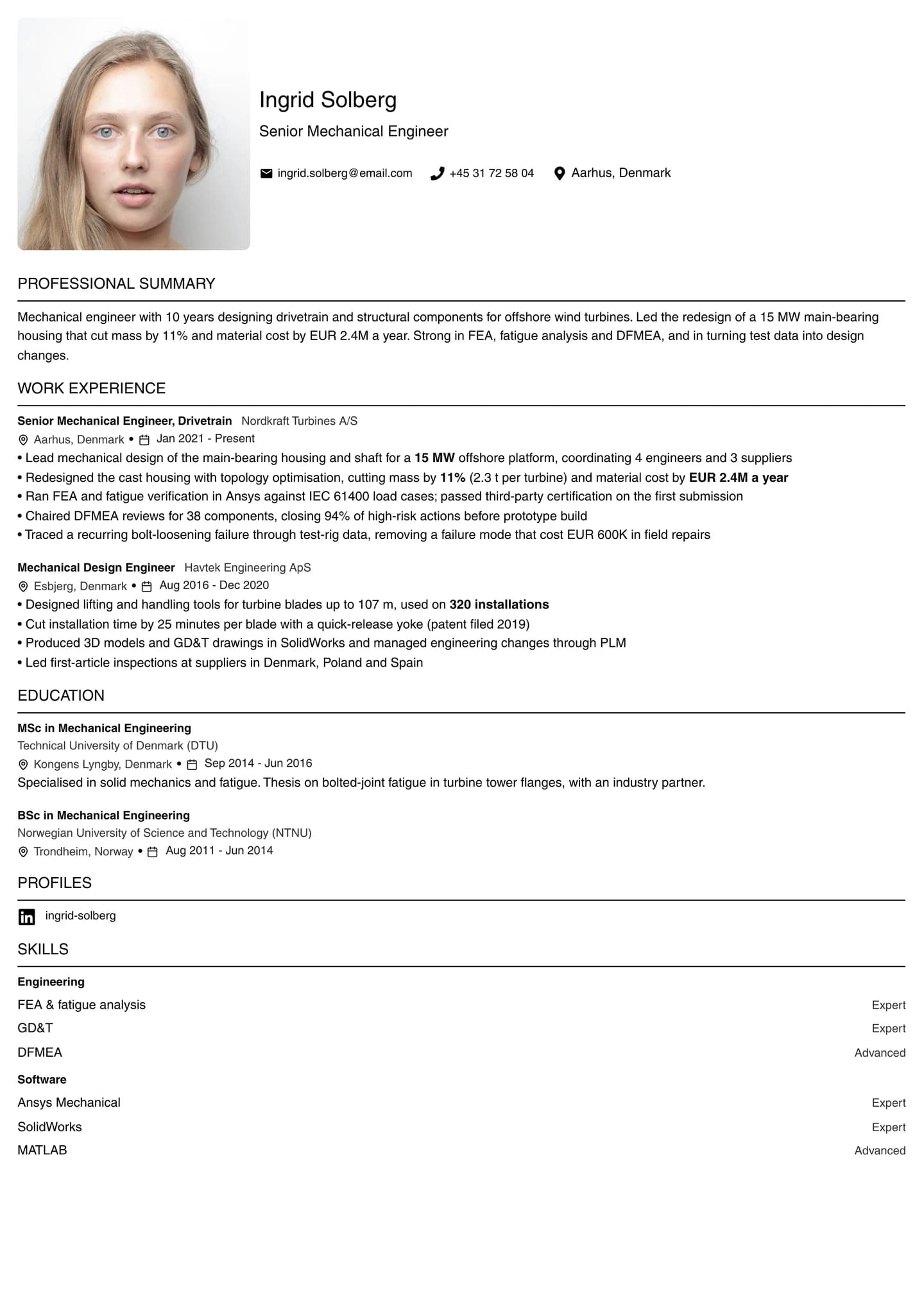
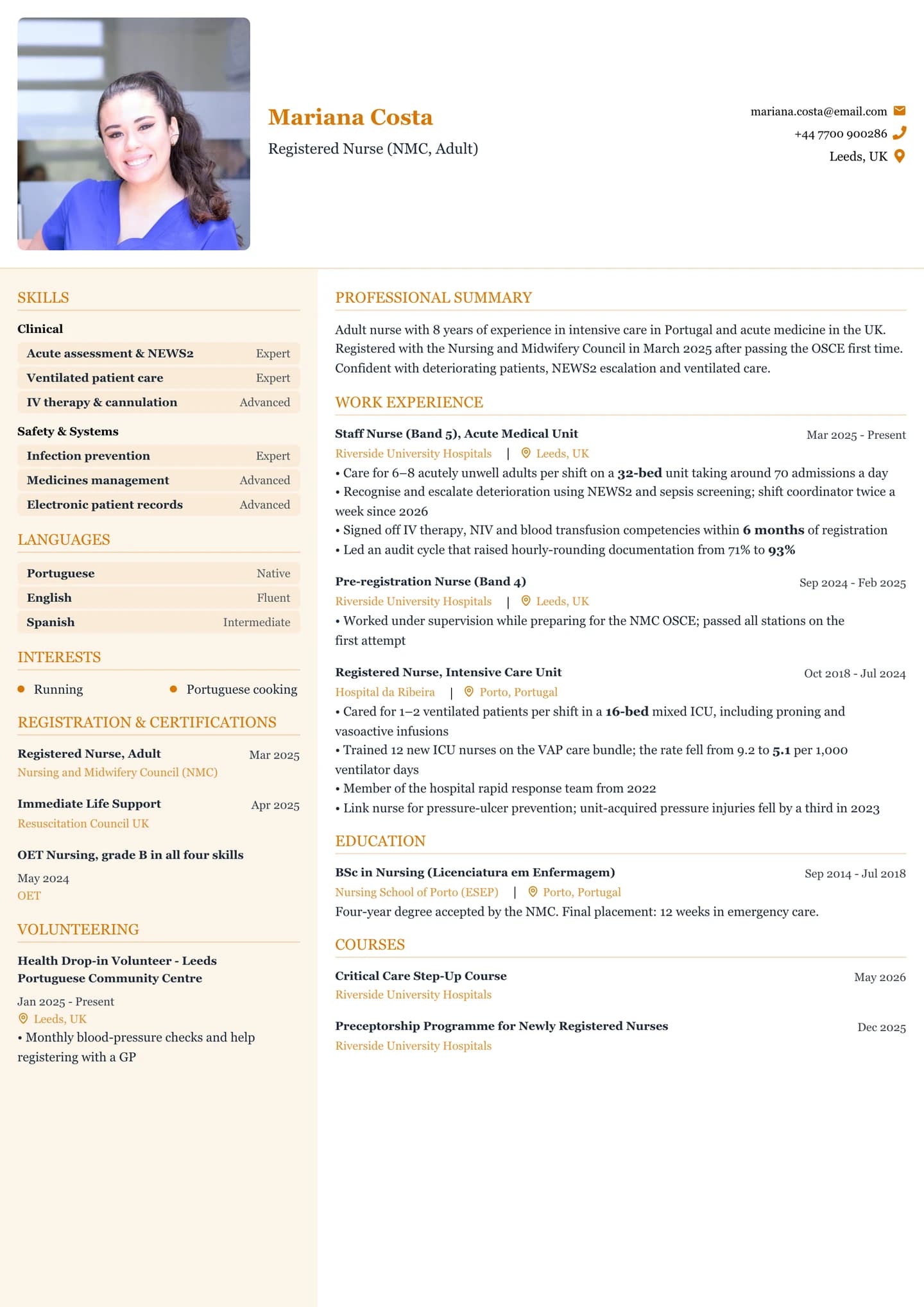
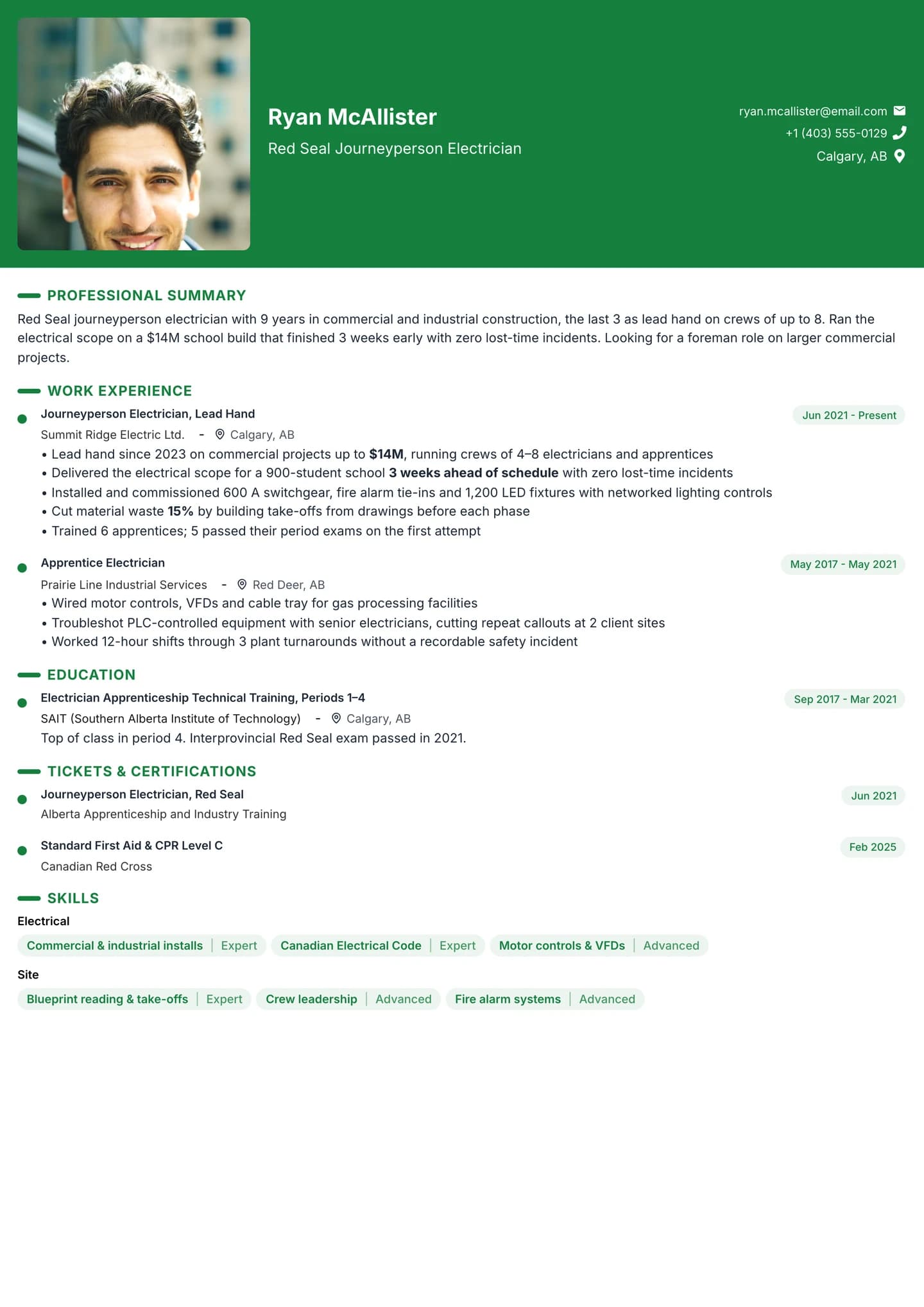
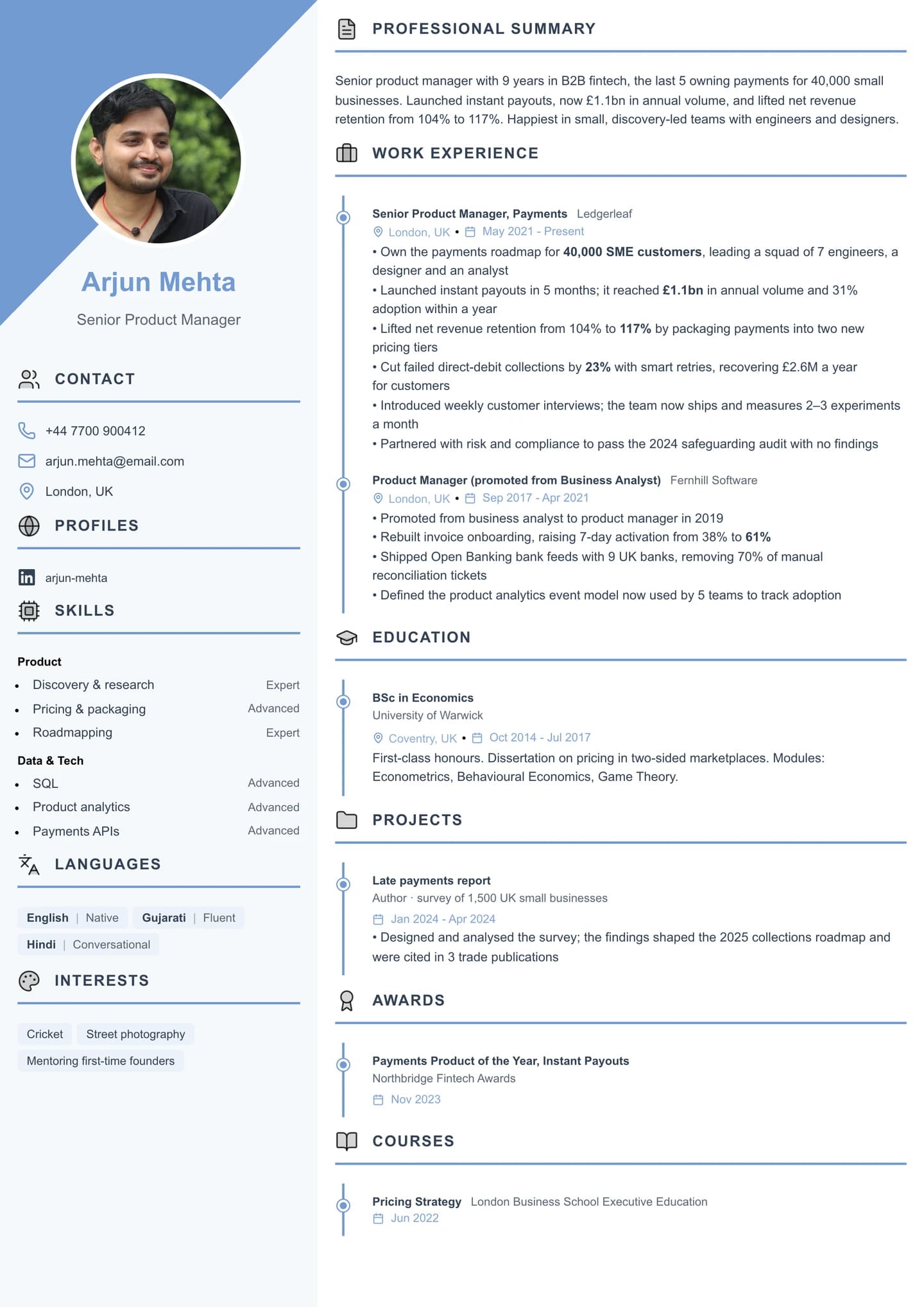
5 of the 14 designs in the resume template library are free: Flux, Zenith, Apex, Onyx, and Nova. The plan for each design named here is in brackets.
- Graduate on Stamp 1G, one page: Zenith (Free). One column, so the Stamp line sits under your name and education can come first when the degree is your strongest proof.
- Experienced, two pages, private sector: Pulse (Pro) uses white space and thin rules to keep two pages readable. Onyx (Free) is the free choice in black and grey.
- Public service, HSE, legal or education: Core (Pro) in serif type with no colour block. Many of these employers use their own application form, as publicjobs.ie does, so the CV supports the form and does not replace it.
- Tech and engineering with a long skills list: Nova (Free) holds skills in a sidebar. Two columns are the riskier choice for older screening systems, so check the exported order.
How do you keep an Irish CV to one or two pages?
- Graduates: one page. Put education first, then placements, projects and part-time work with a result each. List your Leaving Certificate only if you have no third-level qualification yet.
- Experienced applicants: two pages. Page one has to do the selling, so it carries the profile, the right-to-work line and your two latest roles.
- Overseas employers: add one line of context under each (sector and size), then cut older roles to a line. An Irish recruiter will not know a regional bank abroad.
- Keep the page on A4, which is the default in Kaizen CV, and print the preview once to see where page two ends.
JobsIreland, the public employment service, accepts either named referees or a “References available on request” line (JobsIreland). Where to put references covers consent and timing, and ATS-friendly CV rules cover the file.
Which Irish roles change the layout?
Each role has a worked example. Some examples are written for another country, so use them for structure and swap in your Irish qualifications and terms.
- Nurses and midwives: show your registration with the Nursing and Midwifery Board of Ireland, the ward or specialty, and the NFQ level of your degree. Core fits clinical roles. The registered nurse example uses US terms such as BSN and ACLS, so replace them with your own training.
- Teachers: show your registration with the Teaching Council, your subjects, and whether you teach Junior Cycle or Leaving Certificate classes. The teacher example is written for England, with terms such as QTS and GCSE, so translate them.
- Accountants and finance: name your qualification and body (ACA or ACCA) and the standards you work to. Accountant postings use terms such as accountant, financial reporting, month-end close, reconciliation, general ledger, accounts payable, accounts receivable, audit.
- Software engineers: add a one-line stack and links to your code. Software engineer postings use terms such as software engineer, backend, API design, distributed systems, CI/CD, code review.
Questions about CV templates for Ireland
A clean design that holds one to two A4 pages with no photo and a header that leaves room for your right to work. Zenith is free and fits most applications, and Core suits the public service and healthcare.
One to two pages. EURES gives that range, and gradireland advises graduates to aim for one page with two as the maximum.
Not unless the application form asks for one. Choose a design without a photo slot, or place a photo with Flux, Prism or Mosaic only when a form requires it.
On one line under your contact details, stating only what your immigration permission says, for example Stamp 1G with the date it runs to. Recruiters who cannot tell whether you need a permit often assume you do.
Very little. The format is shared: one to two A4 pages, no photo, newest job first. The Irish differences are the right-to-work line, an NFQ level for a foreign degree and the public service’s own application forms.
Not free. You build the CV in Kaizen CV, where some designs are free to use, and the designed PDF or Word download is part of Pro.